

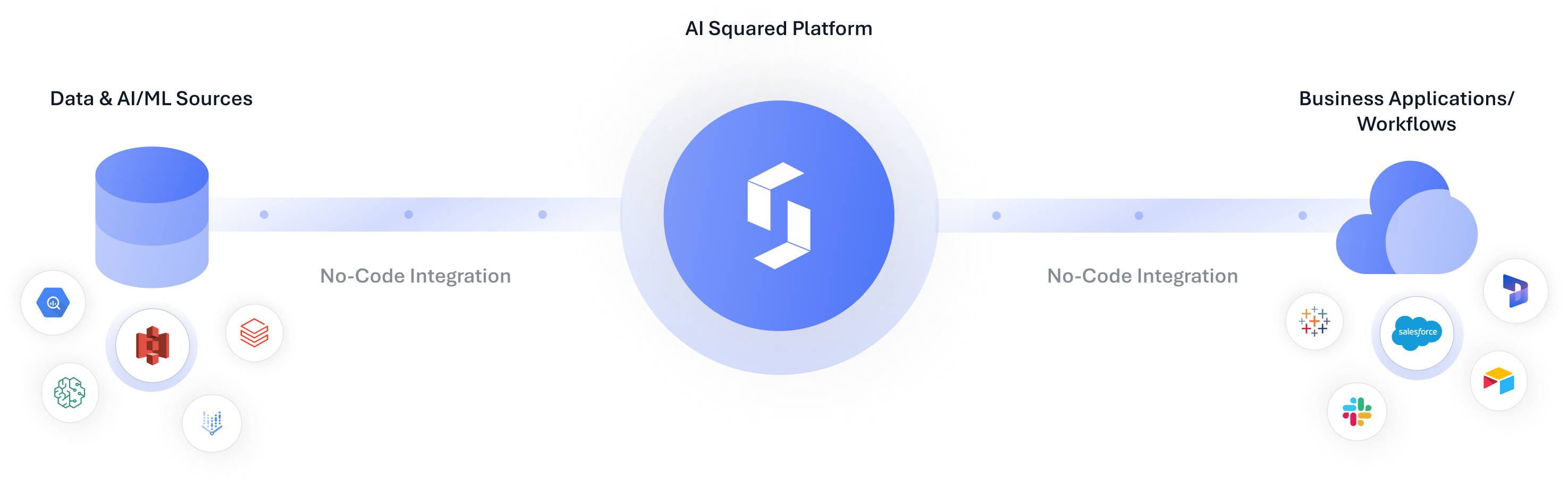
What is AI Squared?
AI Squared helps enterprises accelerate AI adoption at scale - by integrating Artificial Intelligence and Machine Learning (AI/ML) into systems they already use, modernizing legacy systems, and operationalizing agentic AI. From federal teams that need secure, mission-ready solutions to enterprises who need systems that scale across their complex organizations, to mid-market companies seeking plug-and-play capabilities, AI Squared’s software delivers faster adoption, better decisions, and real, measurable impact.Who is AI Squared for?
AI Squared is for data science teams and AI/Analytics teams at large enterprises who are:- Unable to scale AI beyond the pilot stage
- Unable to showcase immediate business impact
How AI Squared Works
- Connect: Integrate disparate data sources and AI sources seamlessly with no-code.
- Learn: Feedback loops continuously improve LLMs making them more accurate and tightly aligned to your organizations processes.
- Orchestrate: Route models, manage policies, enforce governance, observe agentic workflows and ensure uptime.
- Secure: Deliver defense-grade encryption, RBAC, and auditability.
- Embed: AI insights are integrated in the enterprise applications employees already use.
Main Challenges Related to AI Deployment
One of the key challenges in the industry is that AI products do not reach production - About 95% of all AI POCs never make it to production, as per an MIT Report.Why AI Proof-of-Concepts fail to launch:
- Disparate tools:
Fragmented tools (sometimes 10-15 in number) come with their own UI, API, operating model. This makes end-to-end workflows harder to manage and scale. - Complex integrations:
Connecting data sources, models and applications requires time and engineering effort - thereby slowing down time to production and increasing the cost of the project. - Lack of trust and governance systems:
When governance is not built-in, it is harder to manage. It becomes difficult to track and report how AI models collect, use and process data. - Low end-user adoption:
AI insights often require new tools to track and monitor. As a result, it disrupts existing workflows and affects adoption.
AI Squared Architecture
AI Squared’s UNIFI platform implements the AI Controls Model through a unified architecture that addresses all seven layers in an integrated system. Unlike fragmented point solutions, UNIFI provides native capabilities for data connectivity, context preparation, workflow orchestration, governance, delivery, and observability without requiring external integration..png?fit=max&auto=format&n=-MbwV9-QpicPIrse&q=85&s=4b8c3232b773f2d975493ee2891f3bc8)
Architectural Overview
The UNIFI platform architecture consists of 5 primary subsystems:Sources:
UNIFI connects to both enterprise data systems and AI model endpoints. Enterprise Data Sources These include:- CRMs such as Salesforce and Dynamics
- ERPs such as SAP and Oracle
- Data warehouses such as Snowflake and BigQuery
- Databases such as PostgreSQL and Redshift
AI / ML Model Sources The platform also connects to:
- OpenAI
- Anthropic
- AWS SageMaker
- Google Vertex
- Databricks model endpoints
- Custom REST APIs
Organizations can unify fragmented enterprise systems into a single operational layer. This eliminates manual data stitching and reduces integration timelines from months to days.
Data Plane (Connectors and Syncs)
Scalable data movement layer using lightweight connector plugins that implement the Multiwoven Protocol. Each connector handles authentication and interaction with specific systems (CRM, database, warehouse). During sync operations, worker processes execute data transfers between sources and destinations. State management, retries, and scheduling are coordinated through Temporal workflow orchestration. Business value: Organizations can add hundreds of new data sources without increasing operational burden on platform teams. Connectors scale independently, handling parallel data transfers without resource contention.Control Plane
Microservices-based architecture built with Ruby on Rails and TypeScript/React, providing horizontal services for configuring and executing data and AI workflows. The control plane manages objects (data sources, destinations, AI models, workflow configurations) and coordinates all platform operations. It includes the web UI for no-code interaction and REST APIs for programmatic access. Business value: This separation means platform teams can manage system configuration without writing code, while developers can automate deployment through APIs. New data sources or workflow types can be added without platform downtime.Application Plane
User-facing capabilities including the Sparx conversational interface for natural language queries, Insight Dashboard for interactive analytics, Automation Engine for event-driven workflows, and Data Apps for embedding AI insights directly into business applications. This layer orchestrates retrieval from the unified data layer, LLM inference, and result formatting. Business value: Business users ask questions in natural language and receive answers with citations in seconds, without manual report generation or SQL queries. AI capabilities are delivered where work happens rather than requiring separate tools.Consumption Plane
The Consumption Plane represents where AI insights are delivered and consumed. Instead of pulling users away from the systems they already use, UNIFI embeds intelligence directly into existing enterprise and mission systems. This includes:- CRM platforms
- ERP systems
- Collaboration tools
- Financial systems
- Federal mission applications
- Custom internal portals
- Embedded widgets
- Contextual dashboards
- Chat assistants
- Automated recommendations
- Triggered workflows
- Automated workflows
AI becomes part of daily workflows rather than a separate experiment. Users do not switch tools or change behavior. They receive trusted, contextual insights inside the systems they already use. This increases adoption, shortens feedback cycles, and accelerates measurable business impact.